| |
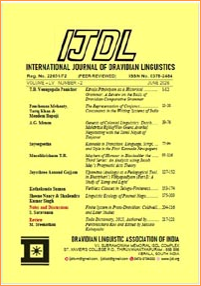
CONTENTS:
KĒRAḶA PĀṆINĪYAM AS A HISTORICAL GRAMMAR : A REVIEW ON THE BASIS OF DRAVIDIAN COMPARATIVE GRAMMAR
T.B. Venugopala Panicker
(A.C. Sekhar Memorial Lecture delivered at the 51st AICDL, Tamil University, Thanjavur, June 2024)
Abstract
Kēraḷa Pāṇinīyam is the best available traditional grammar of Malayalam language; the first edition of which was published in 1896 and its revised second edition in 1917. The second revised version was very much influenced by Caldwell’s work ‘A Comparative Grammar of Dravidian or South Indian Family of Languages’. The present article not only shows the extent of Caldwell’s influence on this work, but also cites the influence of the 14th century work Līlātilakam, a work on Malayalam poetics. This grammar, though synchronic, is written by considering the diachronic aspects also. The important features of Kēraḷa Pāṇinīyam are highlighted in this article.
THE REPRESENTATION OF CONJUNCT CONSONANTS IN THE WRITING SYSTEMS OF INDIA
Panchanan Mohanty, Tariq khan & Mendem Bapuji
Abstract
Research on the scripts and writing systems has located Brahmi as the source of most, if not all, scripts in India. Among these, Devanagari exercises a great privilege over others. Its prominence emanates from various socio-cultural and religious factors that have influenced the intellectual interpretations of the origin and development of scripts in India. As a by-product of these socio-cultural and historical antecedents, scholars have often determined the development of Odia and Bangla scripts from an Old Nagari script and thereby they have ignored the contact these two languages had with Dravidian scripts. Odia and Bangla are two eastern Indo-Aryan languages that have maintained contact with Dravidian languages for centuries and have also mutually affected each other. In this backdrop, the present work offers a comparative study of the writing systems in India with special reference to Bengali and Dravidian. It primarily focuses on the representation of consonantal conjuncts in the scripts of Indo-Aryan languages such as Bangla, Odia, and Hindi and Dravidian languages such as Telugu and Tamil. The central hypothesis of this paper is that the literary and cultural contacts among Bangla, Odia, and Dravidian communities reflect on their writing systems too. In other words, the expression of consonantal conjuncts in Bangla and Odia clearly points to their contact and convergence with Dravidian. This paper analyses the schemes for the representation of consonantal conjuncts across the languages in context here. At first, it discusses the terminologies relevant to writing systems research. Then, it throws light on the characteristics of Brahmi-derived Indian scripts. Next, it focuses on the representation scheme of conjuncts as a variable in the scripts of the Indian languages and concentrates on the representation of consonant conjuncts in Devanagari, Bangla, Odia, and Telugu writing systems and concludes that the variations in the scheme may be due to language contact.
Keywords: scripts, writing systems, Indo-Aryan, Dravidian, conjunct consonants, language contact, convergence.
GENESIS OF COLONIAL LINGUISTICS: DUTCH MAHĀRĀSA RIJKLOF VAN GOENS AVARKAḶ NEGOTIATING WITH THE TAMIL NAYAK OF TANJAVUR
A.G. Menon
(Prof. Nagamma Reddy Memorial Lecture delivered at the 50th All India Conference of Dravidian Linguists at the University of Kerala, Thiruvananthapuram, Kerala [21st to 23rd June 2023] )
Abstract
The focus of this article is the historical contact between Malayalam and Dutch during the 17th and 18th centuries. It was a confrontation between an Indo-European and a Dravidian language. Since their origin took place in two different territories, concepts such as “bridging linguistic gaps”, “zones of colonial contacts” and “spaces of colonial encounter” are useful in the historical analysis.
The Dutch East India Company (VOC) was present on the West coasts of Malabar during the 17th and 18th centuries. It gave importance to spoken Malayalam and left behind a vast reservoir of linguistic data. One of the salient points of this historical language contact is how a colonial power tried to reduce a foreign spoken language into readable texts by using its own writing system instead of learning to write in the alphabets of the strange foreign language.
About 347 (1678-2025) years ago, the verbal monument Hortus Indicus Malabaricus was built. The names of about 745 trees, plants, herbs, flowers, seeds, and creepers were registered in six languages. The present article attempts a deep linguistic study of the historical records in the contexts of data collection, registration, transcriptional novum, phonological and morphological peculiarities, engraving in strange writing systems and the extraordinary talents of the Dutch project leader Governor Hendrik Adriaan van Reede tot Drakenstein.
KANNADA IN TRANSITION: LANGUAGE, SCRIPT, AND STYLE IN THE FIRST KANNADA NEWSPAPERS
Sayeegeetha
(Prof. H.M. Maheswaraiah Memorial Lecture presented at the 52nd All India Conference of Dravidian Linguists at Annamalai University, Annamalai Nagar, Chidambaram, Tamilnadu [19th to 21st June 2025])
Abstract
In this lecture titled ‘Kannada in Transition: Language, Script, and Style in the First Kannada Newspapers’, an effort is made to explore the foundational role of early Kannada print media in shaping the language’s modern trajectory. Language, in its evolving journey, often adapts or innovates scripts to suit communicative needs—especially evident in literature, historical documentation, and public discourse. In the 19th century, newspapers emerged as critical platforms for language dissemination and standardization. This study focuses on three key aspects: (1) the motivations and themes behind the early newspaper of Kannada, (2) a comparative analysis of Mangaluru Samachara and Kannada Samacharavu, and (3) an examination of the linguistic choices - script, vocabulary, syntax, and style—adopted in these early publications. By doing so, the paper underscores how these newspapers not only reflected contemporary realities but also played an active role in the transition of Kannada into a modern, print-oriented public language.
MAYHEM OF HUMOUR IN BLACKADDER THE THIRD SERIES: AN ANALYSIS USING JACOB MEY’S PRAGMATIC ACTS THEORY
Muralikrishnan T.R.
Abstract
Using Jacob Mey’s Pragmatic Acts Theory, this analysis examines how Blackadder’s three scenes enact humor and critique through socially embedded “pragmemes.” The first scene mocks theatrical superstition, using prosodic and physical acts within a domestic ritual. The second illustrates comic misunderstanding, where stage dialogue is misread as political threat, showcasing contextual breakdowns. The third parodies intellectual elitism through linguistic performance, with Blackadder mocking scholarly authority. Across all scenes, humor arises from misaligned speech acts and social expectations. Blackadder consistently acts as a metapragmatic disruptor, highlighting how language is performative, culturally situated, and often unstable in its social function.
Key words: Pragmeme, Speech Acts, Contextualization, Inference, Reference, Relevance, Voice.
UPAMĀNA (ANALOGY) AS A PEDAGOGICAL TOOL IN BHARTṚHARI’S VĀKYAPADĪYAM (PART I): A STUDY OF ‘LAMP AND LIGHT’
Jayashree Aanand Gajjam
Abstract
The ancient Indian grammarian-philosopher-poet Bhartṛhari (circa 5th Century BCE), in his magnum opus ‘Vākyapadīya’ (VP henceforth), presents a remarkably sophisticated account of how language interferes with the formulation of human thoughts with his doctrine of Sphoṭa Śabda (The ‘Word’). Particularly, in the first chapter- the Brahmakāṇḍa, Bhartṛhari develops his argument through a sustained and nuanced use of analogy (Upamāna). In the Indian epistemological tradition, Upamāna is recognized as a valid pramāṇa (means of knowledge), functioning not only as an epistemic instrument but also as a powerful pedagogical strategy. Bhartṛhari’s text exemplifies both dimensions.
This paper examines Bhartṛhari’s philosophy of language through one of his most recurrent and illuminating analogies, viz., the lamp (jyotiḥ) and the light (prakāśaḥ). Drawing on multiple facets of this analogy, resorting to the disciplines of pedagogy, philosophy and linguistics, this paper revisits Bhartṛhari’s distinction and relationship between nāda and sphoṭa, and the madhymā and vaikharī vāk.
In addition to the textual analysis, the paper reflects on the pedagogical significance of analogical reasoning, particularly within language and linguistic studies. The use of analogy serves at least two interrelated purposes. First, it renders abstract or unfamiliar realities accessible by mapping them onto familiar experiential domains. Second, it cultivates metacognitive awareness and higher-order thinking, encouraging learners to reinterpret new knowledge through existing cognitive frameworks. Since analogical reasoning lies at the core of human cognition, it not only enhances conceptual clarity but also fosters creativity and schema formation in learners.
By foregrounding the Lamp and Light analogy, this study demonstrates how Bhartṛhari’s methodological way of explaining his linguistic philosophy carries deeper pedagogical insights itself.
Keywords: Vākyapadīyam, Upamāna, Sphoṭa, Indian Knowledge System, Pedagogy
VERBLESS CLAUSES IN TELUGU-FINITENESS
Kothakonda Suman
Abstract
This paper investigates several properties of verbless clauses in relation to finiteness. Finiteness is one of the crucial topics in the field of descriptive and theoretical linguistics, but has not been particularly well-defined for several years. It has to receive considerable attention in the field. The notion of finiteness is a complex phenomenon in Telugu, and it is not completely clear whether a separate feature or a combination of features decide(s). This paper discusses some of the crucial features of finiteness and explores how different grammatical theories represent finiteness. It further explains the nature of the finiteness and the properties of the verbless clauses such as NP+NP, NP+AdjP and NP+AdvP in Telugu. Although these lack a lexical verb, they can occasionally have an auxiliary verb, particularly with adjective predicates, adverbs, or in the past tense of NP+NP clauses. This paper also examines the morpho-syntactic and semantic properties of these types of constructions in Telugu language.
[Keywords: finiteness, morpho-syntactic properties, Telugu, verbless clauses, aspect
Abbreviations: ACC = accusative; ADJ=adjective(al); ADJP=adjectival phrase; ADV=adverb(ial); ADVP=adverbial phrase; COMP= complementizer; CP=complemetizer phrase; DAT=dative; DEF AGR = default agreement; DIR=directional marker; EXCL=exclusive; GEN=genitive; HON= honourific; INCL=inclusive; LOC=locative; M=masculine; NEG=negation; NM=non-masculine; NOM=nominative; NP=noun phrase; NPST=non-past tense; PL=plural; pro=null pronominal; PST=past; SG=singular; 1=first person; 2=second person; 3=third person.]
(Modified version of the paper presented at International Conference of Linguistic Society of India (ICOLSI-46), 2024.)
LINGUISTIC ECOLOGY OF POUMAI NAGA
Sheene Nancy & Shailendra Kumar Singh
Abstract
The Poumai Naga belongs to the Angami-Pochuri subgroup of the Tibeto-Burman family of languages. According to the 2011 Indian Census, the population of Poumai is 187,180. Poula is a language spoken by the Poumai Nagas inhabiting Manipur and Nagaland's transborder areas. The present paper discusses the linguistic ecology of the Poumai Naga, with brief references to ethno-linguistic demography, linguistic habitat, and language domain. In particular, the paper attempts to investigate the socio-cultural structure of the Poumai, including folk traditions, customs, agriculture, beliefs, and practices. It also provides a basic linguistic description of Poula.
[Keywords: Poumai Naga tribe, Linguistic Ecology, Poula, Tibeto-Burman Language]
FINITE SYSTEM IN PROTO-DRAVIDIAN: CALDWELL AND LATER STUDIES
S. Saravanan
Abstract
In Dravidian linguistics, scholars are divided into two schools of thought regarding the structure of finite verbs in Proto-Dravidian: (a) that finite verbs lacked Person-Number-Gender (PNG) suffixes and (b) that finite verbs included PNG suffixes. Based on forms found in Dravidian languages in general and in Classical Tamil literature in particular as well as on previous research, this study seeks to demonstrate that finite verb constructions with PNG suffixes existed during the early (or primitive) stage of the language and that the loss of PNG suffixes in certain languages is a later development.
Abbreviations
Aiṅ - Aiṅkuṟunūṟu; Eḻ. - Eḻuthaccaṉ, K.G. – Krishnagatha; Kuṟum - Kuṟuntokai; P.N.G. -Person-Number-Gender; Pati - Patiṟṟuppattu, Puṟam - Puṟanāṉūṟu and Līl. – Līlātilakam.
Review
TODA DICTIONARY, Authored by Peribhaskara Rao and Edited by Masato Kobayashi. 2025, Asian and African Lexicon No. 68. Tokyo: Research Institute for Languages and Cultures of Asia and Africa, Tokyo University of Foreign Studies, Tokyo, Japan, Demmy 1/8, Pp.288.
Reviewed by
M. Sreenathan
Abstract
The Toda language, an endangered member of the Dravidian family spoken in the Nilgiri Hills of South India, has a long, yet fragmented, history of documentation. While earlier efforts by missionaries and linguists produced grammatical descriptions and partial lexical lists, a comprehensive dictionary has remained absent. The publication of Toda Dictionary (Peribhaskara Rao, 2025) marks a significant milestone in Toda lexicography. This review evaluates the historical background of Toda lexical documentation, examines the structure and contributions of the present dictionary, and discusses its implications for future research and language preservation.
Keywords
Toda language; Dravidian linguistics; lexicography; endangered languages; Nilgiri Hills
|
|


