| |
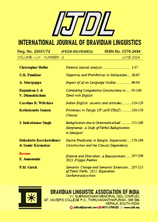
CONTENTS:
1. 52ND All India Conference of Dravidian Linguists (Presidential Address)
N. Bhakthavathsala Reddy
2. VIEWING EARLY INDIA FROM THE SOUTH
E. Annamalai
Abstract
This paper is focused on the early period of the history of India giving the narrative from Southern India, more specifically from the Tamil India. The intellectual tradition of Tamil has aspects unique to it. They include the theoretical position that grammar serves literature, the predicate assigns cases to nouns, nominal compounds made with verbal bases, ecological theory of literary aesthetics, special ways of expressing suggestive meanings, evolution of bhakti poetry, practice of iron smithy, emergence of script, ship building and sea commerce, all of which anteceded them in the northern part of India. It proposes a theory of mutual interaction between regions and cultures to replace the theory of borrowing from the dominant.
[Keywords: Early history, Indian history, South India, Relation of Grammar to Literature, Compound formation, Literary aesthetics, Secondary meaning, Bhakti poetry, Emergence of Script, Iron age, Sea trade]
3. MAYURAM VEDANAYAGAM PILLAI – A VISIONARY FOR TAMIL LANGUAGE IN THE 19th CENTURY
G. Balasubramanian
Abstract
The Socio-politico-linguistic scenario of Tamilnadu of the Nineteenth Century contributed to the rise of Tamil renaissance in the beginning of the Twentieth Century. Robert Caldwell through his work on A Comparative Grammar of the Dravidian or South-Indian Family of Languages, intellectuals, social reformers and creative writes were concerned about the marginalization of Tamil due to Sanskrit’s supremacy and also by the newly introduced English language by colonialist. Mayuram S. Vedanayagam Pillai, who pioneered the novel genre in Tamil, acted as a language planner through his writings and innovative ideas. His contributions to the development of Tamil are examined here from a linguistic perspective.
[ V.I. Subramoniam Memorial Lecture delivered at the 52nd All India Conference of Dravidian Linguists at Annamalai University, Annamalai Nagar, Chidambaram, Tamilnadu (19th to 21st June 2025). ]
4. COMPILING A DICTIONARY FOR THE KHARIA SABAR: AN INDIGENOUS AND ENDANGERED TRIBAL SPEECH COMMUNITY OF EASTERN INDIA
Niladri Sekhar Dash
Abstract
I discuss the challenges I faced while I tried to develop a dictionary for the Kharia Sabar community―an indigenous endangered tribal community living in the state of West Bengal, India. I classify the challenges into two types: extralinguistic and linguistic challenges. The extralinguistic are linked with awareness about the value of such a text among the community members; their attitude towards procurement of data and information from their life, living, culture, history, heritage, and ecology; logistic issues in data collection on-spot interviews; demographic and ethical issues in selection of respondents; availability of funds for conducting elaborate linguistic surveys; collection of lexical data covering all areas of community life; availability of people for text processing, analysis and dictionary compilation; and availability of agencies willing to publish dictionary as a product. The linguistic challenges, on the other hand, are linked with collection of data from community; sufficiency, diversity and variety of lexical data; paucity of lexicographic details; citation of example sentences to determine usage-based sense variations; inadequacy of linguistic description of lexical items for addressing referential and pedagogical requirements; use of pictures, images and diagrams for a visual representation of complex concepts and similar issues. Most of these challenges are linked with theoretical and ethical issues―all of which combine together to make a process of dictionary-compilation an upheaval task fretted with many caveats and shortcomings, particularly in those contexts when folk texts, verbal narratives, written materials and historical records are not available for reference and utilization. Keeping the challenges in view, in this paper, I discuss the strategies that I adopted to overcome the hurdles I faced during the compilation of a dictionary, which is made to preserve and promote the endangered indigenous language against a backdrop of aggression of powerful neighbouring languages. The dictionary that I developed can be used by the Kharia Sabar speakers for general reference and pedagogic purposes, while others can use it for academic, commercial and localization purposes.
[Keywords: Kharia Sabar, dictionary, indigenous, endangered, tribal community, language documentation, pedagogical requirements, lexicography]
[prof. Anvita Abbi Endowment Lecture delivered at 52nd All India Conference of Dravidian Linguists, Annamalai University, Annamalai Nagar, Chidambaram, Tamilnadu (19th to 21st June 2025).]
5. COREFERENTIAL EXPRESSIONS IN TAMIL
Rajendran S.
Abstract
The term co-reference is traditionally used to name the study of how phrases in a sentence connect to objects in the real world. The term 'co-reference annotation' is used in an informal way in corpus works to indicate both the annotation of (generalized) anaphoric information and information about reference proper. A few referential resolution schemes practiced and implemented for languages like English will be explored with the scope of finding a better alternative for Tamil. Anaphora has been studied extensively by Padbanabapillai (2005) for Tamil. Arogiyanathan (1981) explicates reflexivity in Tamil. Lehman (1993) briefly discusses anaphora, reflexivity, and reciprocality in Tamil. Annamalai (2000) elaborates on lexical anaphors and pronouns in Tamil. These analyses have been used to serve our purpose. The paper aims to put forward the linguistic issues involved in finding co-referential expressions in Tamil.
6. A LINGUISTIC ANALYSIS OF TELUGU PROVERBS: A PRAGMATIC STUDY
Anjaneyulu Ghandapuram
Abstract
This paper aims to explore pragmatic study of linguistic analysis of Telugu proverbs, examining how they reflect cognitive processes, conceptual metaphors, and cultural models. Telugu, one of the Dravidian languages primarily spoken in the Indian states of Telangana and Andhra Pradesh, possesses a rich repository of proverbs and idioms that play a crucial role in communication, reflecting the cultural values, beliefs, and worldview of the Telugu-speaking community. This paper employs a comprehensive analytical framework to examine the cognitive linguistic analysis, meanings, functions, and pragmatic implications of linguistic expressions, providing valuable insights into their social, cultural, and communicative dimensions.
[ Keywords: Telugu proverbs, Pragmatic, cultural values and functions ]
7. VERB DOUBLING CONSTRUCTIONS IN MEITEILON: UNDERSTANDING THE TRIGGERS
Lalit Rajkumar
Abstract
Verb doubling constructions take place only when the verb is fronted for topicalization or focalization (Koopman 1984, 2000; Abels 2001; Landau 2006; Vicente 2007; Aboh and Dyakonova 2009; Trinh 2011; Cheng & Vicente 2013; Rajkumar 2018, 2021). Such an obligatory fronting occurs in order to fulfill some additional requirements. This additional need is affected by the verb to do two different things namely, a) an interaction with the information structure components through topicalization or focalization; and, b) the other is to interact with the verbal inflections. Such an observation for verb doubling constructions has also been noted in the literature (Koopman 1984, 2000; Abels 2001; Landau 2006; Harbour 2008; Aboh and Dyakonova 2009; Trinh 2011). Thus, the paper aims to unweave the units of information structure which are responsible for triggering verb doubling constructions in Meiteilon, a Tibeto-Burman language.
[Keywords: Verb doubling; Meiteilon; Topicalization; Focalization; Information Structure
Abbreviations
ACC = Accusative; Assr = Assertive; CT = Contrastive (Topic/Focus); Dat = Dative; Deic = Deictic marker; DISJ = Disjunct(ive); Erg/ERG = Ergative; Evid = Evidential; FinP = Finite Phrase; Foc = Focus; Ind = Indicative; IP = Inflectional Phrase; LL = Least Likely (focus sensitive particle); Loc = Locative; Nzr = Nominalizer; Perf = Perfective; Top = Topic; V = Verb (Lexical); VC = Verbal Connector; Vol = Volitional; VP = Verb Phrase (Lexical Projection); vP = verb Phrase (Functional Projection); Y/N = Yes - No Question marker]
8. MULTILINGUAL NATURE OF KASARAGOD REGION
Basavaraja Kodagunti
Abstract
India is renowned for its multilingual nature; however, Kerala, according to recorded statistics, exhibits more monolingual characteristics, with Malayalam being the predominant language spoken by 97.027% of the population. This trend is observed across most of the regions of Kerala. However Kasaragod district located in the northernmost part of Kerala, presents a more multilingual and linguistically diverse landscape within the state. This paper aims to highlight the linguistic diversity of this district. It explores the interesting correlation between the lower percentage of Malayalam speakers, lower literacy rates, and a higher proportion of tribal populations. The data from the district are compared with state-level statistics.
[Keywords: Kasaragod, Kerala, Linguistic Landscape, Multilingualism, Literacy Rates, Tribal Population, Linguistic Diversity]
9. EXPLORING CROSS-LINGUISTIC INFLUENCE IN TRILINGUAL LANGUAGE ACQUISITION: A CASE STUDY OF KANNADA SPEAKERS LEARNING HINDI THROUGH ENGLISH
Uzma Afreen, M.J. Warsi & Sakkan Thennarasu
Abstract
This case study investigates the interlanguage development of a Kannada-speaking learner acquiring Hindi (L3) through English (L2) within a formal trilingual instructional setting. The study analyses cross-linguistic influence manifested in the learner’s phonological, morphological, and syntactic production, highlighting how features from L1 (Kannada) and L2 (English) shape Hindi acquisition. Particular attention is given to perceptual assimilation, phonological substitution, morphological transfer, and syntactic mapping challenges, especially those arising from differences between English and Hindi tense–aspect systems. The study also documents the learner’s strategic use of code-switching as a cognitive and communicative resource during Hindi production. Although based on a single participant, the analysis offers micro-level insight into how multilingual learners negotiate competing linguistic systems and illustrates the types of pedagogical scaffolding required in such contexts. The findings underscore the need for instructional models that are responsive to the psycholinguistic demands of trilingual learners and recognise the role of cross-linguistic influence in shaping L3 development.
[Keywords: Trilingual Acquisition, Cross-Linguistic Influence, Kannada, Hindi, English, Case Study, Interlanguage, Multilingual Pedagogy]
10. A THEMATIC ANALYSIS OF SUFFIX ORDERING IN MANIPURI
Heisnam Kenny Devi
Abstract
The present paper aims to study and explore the morphological structure of Manipuri, a Tibeto-Burman language, by examining the ordering of suffixes within words. Manipuri suffixes are much more when compared to prefixes. And the study is strictly limited to verbal suffixes. Data were gathered from a range of naturally occurring Manipuri texts or speech applying native speaker’s intuition. The analysis reveals that suffix ordering in Manipuri is not random but follows a consistent hierarchy based on grammatical function and semantic scope.
[Keywords: Morphology, morphotactics, suffix-ordering, Tibeto-Burman, Thematic analysis
Abbreviations
AGR = agreement, ASP = aspect, CAU = causative, COM = completion, CON = conditional, COP = copula, DET = determiner, DIR = directional, EXE = excessive, FUT = future, HAB = habitual, IMP = imperative, LOC = locative, MD = mood, NEG = negative, NOM = nominative, P = person, PAS = past, PER = perfective, PL = plural, REF = reflexive, VR = verb root]
Review
A DICTIONARY OF SANSKRIT, PRAKRIT AND PALI WORDS IN TAMIL AND MALAYALAM by N. Gopinathan Nair, 2022, International School of Dravidian Linguistics, Kerala, Crown ¼, Pp. 988, ₹.2300/- US $. 230.
Reviewed by
N. Muraleedharan Nair
Abstract
A Dictionary of Sanskrit, Prakrit and Pali words in Tamil and Malayalam by N. Gopinathan Nair is a treasure of many rare words in Tamil and Malayalam. This dictionary is a pointer to a past when Sanskrit, Prakrit and Pali languages spread in South India. The former Tamiḻakam which included the present Tamil Nadu and Kerala was greatly influenced by these three languages. Jainism, Buddhism and Vedic Hinduism spread to South India slowly and mingled with the language and culture of Tamiḻakam. Though Malayalam and Tamil later developed into separate languages, this influence is reflected in our common culture. Gopinatha Nair’s dictionary throws more light into the interiors of this cultural and linguistic union.
[ Keywords: Sanskrit, Prakrit, Pali, words common and shared, cultural and linguistic union
Abbreviations : n - noun, Pkt. - Prakrit, ML - Malayalam Lexicon, Ma. Malayalam, Gu. - Gundert, CDIAL - A Comparative Dictionary of Indo-Aryan Languages, Skt. - Sanskrit, TL - Tamil Lexicon, c - circa (century)]
|
|


